

SW WA Drought Hub: Workshops
2025
With support from the SW WA Drought Hub, Gascoyne Catchments Groups will deliver two different workshops across June & July 2025.
Workshop 1: Strengthening Relationship that Support Resilient and Evolving Pastoral Systems
(COMPLETED)
Project Summary:
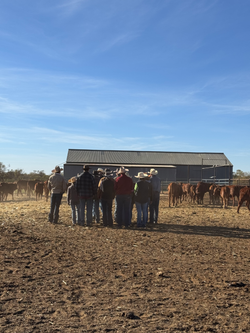
This 2.5-day workshop brought together 17 participants from across the Gascoyne pastoral community to upskill in practical, cattle handling. Facilitated by Steve Burke, the training integrated foundational and advanced techniques in cattle movement, stockmanship positioning, and behavioural understanding, all underpinned by a cattle and safety-first philosophy.
Beyond technical skills, the workshop explored leadership, communication, and team culture, emphasising how human mindset and behaviour directly impact livestock performance, business efficiency, and long-term station resilience.
Key Activities & Learning Areas:
• Theory and Application: Participants were introduced to the science of cattle behaviour and stress response, including the role of sympathetic and parasympathetic systems in animal performance and welfare.
• Low-Stress Stock Handling: Practical sessions focused on pressure and release, positioning, body language, and reading cattle responses, improving timing and flow in handling.
• Team Dynamics and Personal Development: Sessions built around group connection, managing pressure, resilience, and mindset fostered a positive team culture and stronger leadership on-station.
• Applied Station Work: Exercises included yard work, mustering, and drafting using station cattle and infrastructure, replicating real-world working conditions.
• Next Generation Leadership: Young voices—Jack Tierney, Lily Climas and Lily Phillips, shared reflections on working with cattle, managing mindset, and what good stockmanship looks like today. Group Presentations – the final day of the workshop, participants worked to pull together what they had learnt so far, presenting those finds to the group
Participant Feedback:
Participants reported transformative shifts in how they view animal behaviour, their role as handlers, and the broader impacts of stress on livestock. Comments included:
• “Cattle are always right – if something’s not working, it’s on us to adjust.”
• “I’m now focused on how to stay calm, even when the job gets tough.”
• “We’re not just learning to move cattle; we’re learning to work better as people, together.”
Others noted renewed confidence, interest in further skill development, and motivation to experiment with new approaches.
Workshop Video: https://youtu.be/ngmfnebVEmo
Workshop 2: Cattle Reproductive Health
(COMPLETED)
Aim:
To provide vital additional resources to a producer group so that they can deliver an event which allows for the pastoral community to get together in a safe and open environment for both social and knowledge learning activities. Animal husbandry skills are critical in rangeland environments where there are usually very restricted opportunities to yard and treat animals; grazing occurs over vast areas, often experiencing high extremes in weather, and commonly herds are highly mixed in composition (class, breed, etc). Controlled mating and calving have it’s unique challenges in these environments.
Background:
The Gascoyne Catchments Group at its 2024 forum discussed and surveyed members and established: Hosting events that are designed by and for younger members of the pastoral community is a priority.
•Demonstrations and learning about veterinary practices with animals in the yard and race is a priority for young members and station managers alike, with learning of pregnancy testing the highest priority.
.•has a segment where pastoralists share what they have been doing on their properties. This is usually in the form of rehydration and building a resilient landscape. Additionally, for both groups, there are several industry presentations to help with climate resiliency and knowledge sharing.
Participant Feedback:
- Nutrition plays a large part in reproductive health
- Conditions of animals overall when they become pregnant will impact not only them but their progeny in the long run.
- Manual palpation in some cases is easier and in others provides a subjective outcome for fetal age
- Infertility is more to do with the males than the females
Presentation series from Dr Kelsey Pool
Episode 1: Introduction to pregnancy scanning
Episode 2: Logistics of cattle pregnancy scanning
Episode 3: Ultrasound basics
Episode 4: Interpreting an ultrasound image


 |  |  |  |  |  |  |
|---|---|---|---|---|---|---|
 |  |  |  |  |  |  |
 |  |  |  |  |  |  |
 |  |  |  |  |  |  |
 |